I woke up today with a raging sinus headache and the beginnings of what will likely become a congested cough and general miserable condition over the next few days. I headed to the kitchen for some elderberry syrup that I made a few weeks ago…and realize sadly that it’s almost gone. Waaahh!
When I stopped being a whiny baby haha, I realized I have plenty of dried elderberries and all other necessary ingredients so I am simmering as I write.
So what is it about elderberry syrup that would cause me to prepare a new batch as soon as I realized I am almost out? Especially when I’m feeling like this?
Because it really helps you feel better faster!
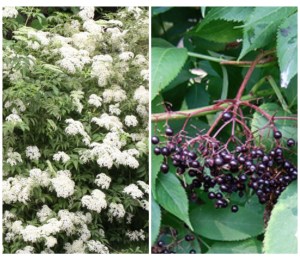 European Elder, sambucus nigra, also known as black elder or common elder, is a member of the Adoxaceae family. It is a shrub or a small tree, with white flowers blossoming around mid-summer and berries appearing late summer into early fall. The fruit turns dark purple when ripe and must be cooked before eating. This is because the seeds, as well as the leaves and bark, contain components that are toxic to humans. It probably won’t kill you, but will likely give you serious GI distress including vomiting and diarrhea. Don’t worry, they are perfectly safe when cooked!
Both the flowers and berries are used for their medicinal qualities. While elder has a long list of uses, today I’m going to focus on its most well-known use – as an antiviral.
You may have heard that elderberry syrup is good for colds and flus, and the research backs this up. Elderberry is shown to shorten the severity and duration of cold and flu symptoms by up to four days when taken within 48 hours from the onset of symptoms. The elderberry extracts not only inhibit viral replication abilities, but also boost immune response.
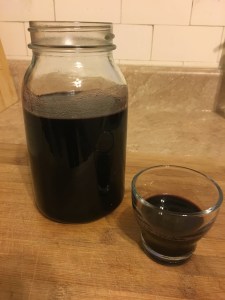 Elderberry tea, syrups, and extracts are widely available in drug and grocery stores. They are often combined with other herbs in proprietary blends, and there are even formulations for children. They can be pricey, but it’s an option if you can not or do not want to make your own. Honestly, making your own elderberry syrup is not really that difficult and is definitely more cost-effective.
There are countless variations of elderberry syrup recipes. Mine is obviously tweaked to my personal taste. I also added calendula, because why not? I have plenty and it has numerous properties that should be useful in this brew.
The other ingredients in this recipe bring their own beneficial properties to this syrup. Cinnamon, ginger, clove, and honey have all been used to alleviate symptoms of colds and flus for centuries.
There are no hard rules about this recipe. You can and should tailor it to your own personal preference. Change up the proportions, add different herbs – be creative and make it your own!
Elderberry Syrup
1 cup dried elderberries
3 cups of filtered water
3 TBS chopped, fresh ginger (I like ginger)
3 cinnamon sticks
1 TBS whole cloves
1 cup raw honey
1 TBS dried calendula flower
Combine berries, water, ginger and cinnamon in medium saucepan. Bring to a boil, cover and simmer until reduced by about half. (Around 45 minutes). Remove from heat and let sit for about 15 minutes before adding calendula. Stir, cover, and allow to cool until almost room temperature. Using a hand-held masher, mash the entire concoction to get as much juice as possible, then strain through a fine mesh strainer or cheesecloth. Add honey and stir until dissolved. Store in a sterilized container and keep it in the fridge.


The recommended adult dosage is between 1tsp. and 1T per day for general immune support. The recommended dose increases to 1tsp. to 1T every 3-4 hours during an acute illness. Trust me, this won’t be difficult. It’s not hard to knock back a shot of this and want more…it’s delicious! I might try it on pancakes!
Sambucus Canadensis, also known as American black elder, is the variety that grows here in the northeastern US. As a close cousin of European elder, the two are often used interchangeably, so foraging for my own berries may be an option.
For now, I’m going to relax with a cup of hot tea and pretend my head is not pounding.
 Pathways and Potions
Leave a comment