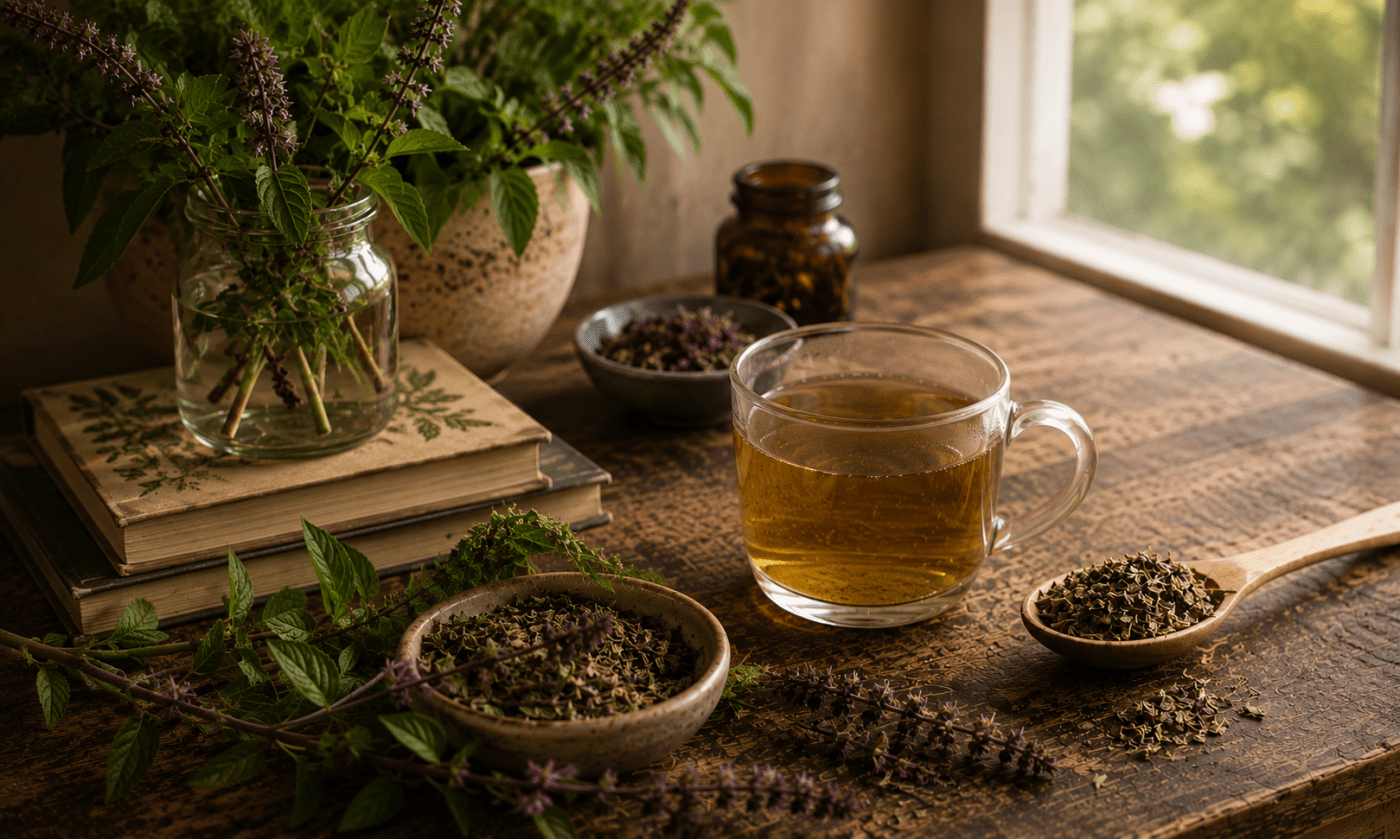
Tulsi is one of the first herbs that I ever wrote about, and after several years, it’s one that I continue to use regularly.
I was initially intrigued by a quote that referred to tulsi as “liquid yoga.” As someone who understood the benefits of yoga, but couldn’t find the time (or discipline) to commit to a regular practice, the idea of discovering a “hack” was appealing. Especially an inexpensive hack that I could also easily grow for even less.
Tulsi, also known as holy basil, doesn’t have the instant “herbal remedy” recognition of something like chamomile or ginger. And unlike some of the current trendy herbal options or products, it hasn’t been marketed aggressively as the single answer to every problem you’ll ever have.
But tulsi has been used for thousands of years in Ayurveda as a restorative and supportive herb. Today, it’s commonly classified as an adaptogen, a modern term for herbs that may help the body adapt more effectively to stress.
And that’s only part of what makes it so interesting.
Research into tulsi has looked at everything from stress and cognitive function to blood sugar and metabolic health.
So when you look at it through a midlife lens, tulsi becomes particularly relevant.
Stress, disrupted sleep, mental fatigue, and changing blood sugar regulation are not exclusive to midlife or menopause, and tulsi is not considered a “menopause” herb.
But many of its traditional uses and emerging modern research happen to overlap with some of the things that can make midlife feel particularly challenging.
What Is Tulsi?
Tulsi (Ocimum tenuiflorum formerly known as Ocimum sanctum) is a member of the mint family and a relative of the basil you probably already have in your spice cabinet or garden.
There are several types of tulsi, including Rama, Krishna, and Vana, which are native to India. Their appearance and flavor vary somewhat, but they share many of the same medicinal compounds. Like other aromatic members of the mint family, tulsi contains a variety of active plant compounds, including eugenol and rosmarinic acid, that contribute to its antioxidant, anti-inflammatory, and other biological actions.
While tulsi can’t fix your job, empty your inbox, make your family stop asking you so many questions, or add three extra hours to your day, it might help support the systems your body uses to deal with all of that.
Stress, Resilience, and the Midlife Pressure Cooker
Stress isn’t unique to women over 40, but midlife has a remarkable ability to stack stressors on top of one another.
Work. Family. Aging parents. Changing relationships. Financial responsibilities. Sleep disruptions. Hormonal changes. Often one thing after another that never seems to ease up.
When you’re in the pressure cooker long enough, one stressor can roll into another without giving you much of an opportunity to rest, recover, and return to baseline.
Tulsi has traditionally been used as a restorative herb during periods of physical and mental stress, and modern research has begun exploring its effects on perceived stress, mood, sleep, and other measures associated with the stress response.
Tulsi isn’t sedating. You don’t drink a cup of tulsi tea and suddenly need a nap. Many people actually drink tulsi in place of coffee for a steady focus rather than the burst (and eventual crash) of caffeinated energy.
Instead, I think of it as an herb for resilience—something that may help support the body’s ability to handle stress without pushing you upward like a stimulant or pulling you downward like a sedative.
That makes it appealing when you’re both exhausted and wound up. Which, as many of us know, seems to be one of midlife’s specialties.
Mental Fatigue, Focus, and Mashed-Potato Brain
Some days my brain is sharp and capable. I feel like I can handle anything.
Other days it seems to have been replaced with mashed potatoes. What day is it?? You have to laugh!
If you’ve ever walked into a room and completely forgotten why you’re there, put the frozen berries in the cabinet, or stared at a familiar word until it suddenly looks like something you’ve never seen before, you know what I’m talking about.
Cognitive changes in perimenopause and menopause are real, but hormones aren’t the only thing affecting how clearly we think.
Chronic stress, poor sleep, blood sugar swings, mental overload, and plain old exhaustion can all contribute to difficulty concentrating and that frustrating sense that your brain isn’t firing on all cylinders.
Tulsi has traditionally been used to support mental clarity and cognitive function, and some modern research has begun looking at its potential effects on memory, attention, and cognitive performance.
If stress and fatigue are contributing to menopausal brain fog, it makes sense to pay attention to an herb that supports stress resilience while potentially supporting cognitive function.
Sometimes we don’t need something to make us sleepy or to give us more energy. Sometimes we just want our brains back…and this is one of the things I find particularly appealing about tulsi.
Tulsi and Metabolic Health
This is another aspect of tulsi that may be interesting and relevant for women in midlife.
Researchers have also investigated tulsi’s effects on blood glucose, insulin sensitivity, cholesterol, and other markers of metabolic health.
That’s important because our metabolic landscape can begin changing during perimenopause and menopause.
Hormonal changes, loss of muscle mass, sleep disruption, chronic stress, and changes in body composition can all influence how effectively the body manages glucose. This doesn’t mean that everyone in midlife suddenly has a blood sugar problem, just that it’s easier to develop problems over time.
Overall dietary patterns, consistent movement, strength training, quality sleep, and stress management matter far more to your body and long-term health than adding a particular herb to your tea.
Tulsi may be a helpful addition to those foundations, but it is not a replacement for those foundations.
And there’s an important flip side to this potential benefit.
If an herb has the ability to influence blood glucose, that also means it may be contraindicated in some. Someone taking medication that lowers blood sugar, or someone who tends toward hypoglycemia, should definitely check with their health care provider before adding tulsi to their regimen.
Herbs can have real physiological effects–that’s why we look to them for support.
What Else Does Tulsi Do?
Stress support may be tulsi’s current claim to fame, but traditionally it has been used much more broadly.
Tulsi contains numerous plant compounds with antioxidant and anti-inflammatory activity, and research has explored possible effects on immune function, cardiovascular health, respiratory health, and digestive support.
I find that herbs are usually more useful when we understand their overall personality and where they fit.
And tulsi’s personality, to me, is one of resilience. It’s an everyday herb that helps support the body when life keeps demanding a little too much of it.
How to Use Tulsi
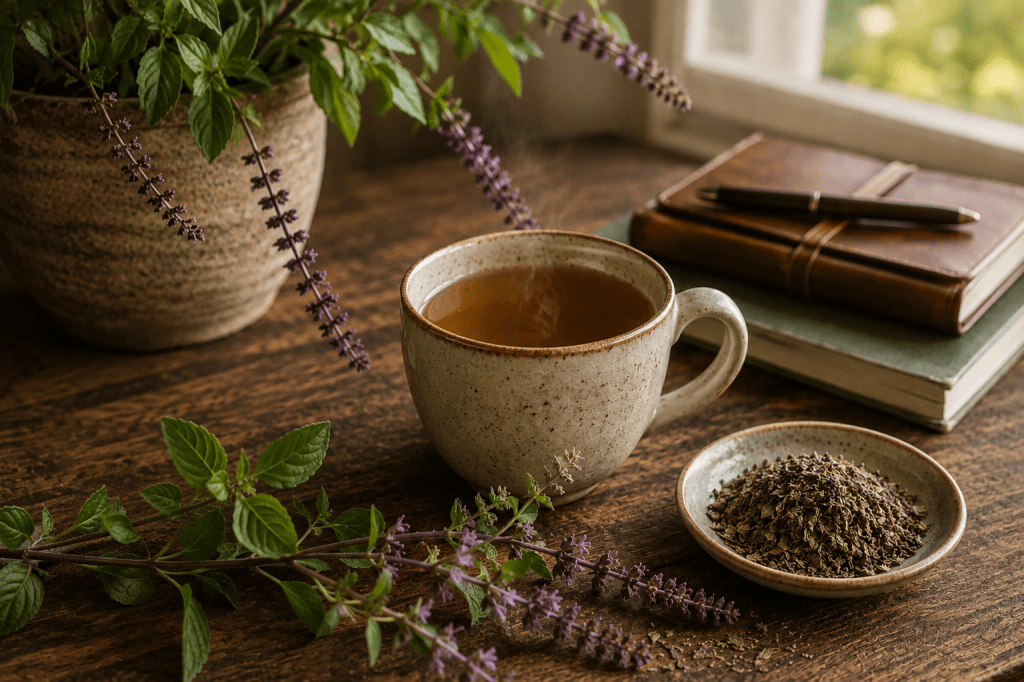
One of tulsi’s biggest advantages is that it’s simple to use. It makes a genuinely good cup of tea.
Tulsi has a warm, aromatic flavor that’s somewhat reminiscent of basil but softer and more complex. Depending on the variety, you may notice slightly spicy, peppery, floral, or clove-like notes.
For a simple tulsi tea, dried tulsi can be steeped in hot water for around 10–15 minutes. You can drink it on its own or blend it with other herbs depending on what you’re looking for.
Tulsi pairs beautifully with herbs such as lemon balm when you want something calming, ginger or cinnamon when you want something warming, or mint when you want a lighter, refreshing tea.
And if you’re interested in growing medicinal herbs, tulsi is an easy one to grow yourself. Fresh leaves can be used for tea, and the plant can provide plenty of material for drying throughout the growing season.
Temperate tulsi (Ocimum africanum) is especially easy to grow here in the northeastern U.S. Its chemical profile differs somewhat from the traditional Indian varieties, so it isn’t necessarily interchangeable with them in research or herbal preparations.
I grow temperate tulsi every summer, even if I don’t intentionally plant it. It readily self-seeds, so sometimes you find a random tulsi plant somewhere in your yard. It’s also perfectly happy growing in a container (or three!). It has a spicy, fruity, almost bubblegum-like (to me) flavor that I absolutely love as iced tea.
I also purchase Rama tulsi regularly.
You can find tulsi sold as loose dried herb, tea bags, tinctures, capsules, and standardized extracts.
Remember, the preparation matters.
A pleasant cup of tulsi tea is not equivalent to taking a concentrated extract, and dosages aren’t automatically interchangeable between different products.
Quality also matters.
Herbs don’t stay potent forever, and quality can vary considerably depending on where and how they were grown, harvested, processed, and stored. Buy the best-quality herbs you reasonably can from well-trusted sources, and don’t expect the dusty bag at the back of the cabinet from six years ago to be at its best.
Is Tulsi Safe?
For most healthy adults, tulsi consumed in reasonable amounts as tea or food is generally considered well tolerated.
As discussed above, tulsi may affect blood glucose and there are some additional cautions to keep in mind. Tulsi is generally not recommended for medicinal use during pregnancy because of limited human safety data and concerns raised by animal studies. There are also potential concerns related to fertility and blood clotting, particularly with concentrated preparations.
If you’re preparing for surgery, take prescription medications, especially medications that affect blood sugar or clotting, or have a medical condition, check with your doctor or pharmacist before using tulsi therapeutically.
The Bottom Line: Should You Try Tulsi?
If stress, mental fatigue, or feeling generally worn out have become regular parts of your life, tulsi is an herb worth getting to know.
Tulsi is accessible, pleasant enough to use regularly, and supported by an interesting history of traditional use and a growing body of modern research.
I personally enjoy tulsi tea regularly. It’s not the “life hack” I imagined years ago that would somehow give me the benefits of doing yoga without actually doing the yoga, but it does help me feel steadier, more resilient, and less foggy on those mashed-potato-brain-days.
And in midlife, I think that’s a useful thing to have in your “medicine cabinet.”


Tulsi did well in a 30-day check I ran on adaptogen claims, which is rarer than it should be: the 2017 review of 24 human studies leaned favorable, and a 2018 meta found modest glucose and lipid drops. Mechanism still unidentified, evidence still small, but ‘liquid yoga’ is one of the few labels that mostly survives contact with the literature. One footnote I keep: the essential oil is a different creature from the cup (eugenol-heavy), so the tea stays the gentler ritual.
LikeLike