
The Midday Crash
You know how this is…
Your day is moving along fine. You’re getting things done, feeling like you have a handle on things and then suddenly–it hits.
The irritability.
The slight shakiness.
The sudden, desperate need for a sugary latte and a nap.
We’ve all been there…
But when I hit midlife, I began to notice that “there” became my permanent residence. It wasn’t just the afternoon slumps; it was the 3AM wake-ups where I felt wired for no reason, only to start the next day with a headache and a short fuse.
It’s easy to blame “stress” or “getting older,” and assume it’s just another new normal we have to live with.
You may not realize that there is also a silent conductor pulling the strings behind your mood, your sleep, and your energy: Your blood sugar.
Most of us hear words like “blood sugar” or “glucose” and think of restrictive diets or doctor’s offices. We get “hangry” and assume it’s simply a lack of food.
But that’s only part of the picture.
Blood sugar isn’t just about what you eat; it’s about how your body responds to your entire life.
Once you understand how things work and affect your body, things that seem random start to make a lot more sense.
The Invisible Conductor
Blood sugar is how your system manages energy from moment to moment, behind the scenes. You can eat a perfectly balanced meal and still feel “off” a few hours later if the rest of your day is working against you.
Stress is a primary driver. When you’re under pressure—whether it’s a packed schedule or mental overload—your system releases cortisol. One of cortisol’s main jobs is to dump sugar into your bloodstream for quick energy.
Now, your body is doing exactly what it’s supposed to do here: helping you “fight or flee.” This is incredibly helpful if a bear is chasing you!
But when the “bear” is just a long to-do list, that sugar spike eventually leads to a crash, leaving you wondering what just happened.
Sleep and hormones play their roles, too. When you aren’t sleeping well, your body struggles to regulate hunger signals the next day, making cravings nearly impossible to “willpower” your way out of.
Then, there are the perimenopause hormone shifts. The rollercoaster feels steeper because the “buffer” of estrogen and progesterone is thinning. That means your system now has less room for error before it tips.
That’s why the habits that used to be fine—the late-night snack, the extra cup of coffee, the back-to-back meetings—now send our systems into a tailspin.
The Subtle Signs
Blood sugar swings aren’t always obvious, especially if you’ve eaten. Often, it’s just a series of little things that don’t quite add up:
- Energy that crashes out of nowhere.
- An unexplained edge of irritability.
- A jittery, anxious feeling… even when nothing is technically wrong.
- Waking up at 3:00 AM, wide awake and wired.
- Craving sugar or carbs like your life depends on it.
- Brain fog that makes it feel like you can’t get traction.
The Connection: Mood, Sleep, and Hormones
Everything is connected in a feedback loop:
Mood: When blood sugar swings too quickly, your brain perceives it as a survival threat. That “on edge” feeling is a physiological stress response, not a character flaw.
Sleep: If blood sugar drops too low while you sleep, your body releases cortisol to bring it back up. That surge is the engine behind those “wired” middle-of-the-night wakeups.
Hormones: Instability adds a heavy “stress tax” to your system. This creates more demand on an already shifting hormonal landscape, making the transition feel more intense and less predictable.
What Actually Helps
It’s easy to overcomplicate things, but you don’t need a total life overhaul or complex approach. You just need to support your body. This isn’t about rigid rules; it’s about sending a signal to your nervous system that it is safe and nourished.
Eat for Stability (The “Holy Trinity”)
Instead of counting calories, focus on balance.
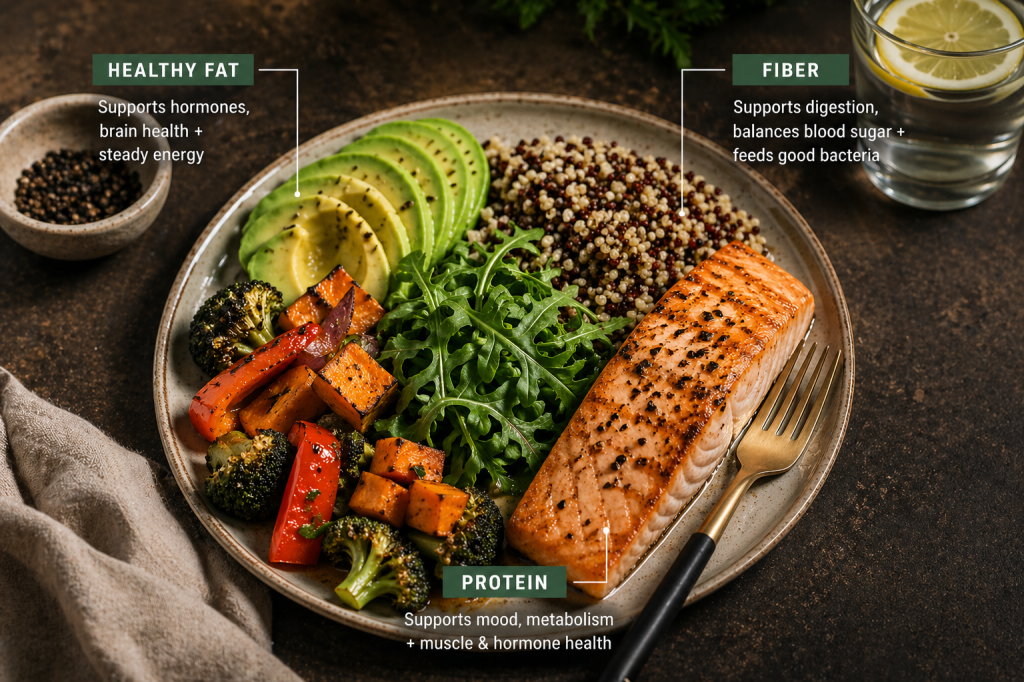
When we eat carbohydrates alone, blood sugar spikes and then retreats, leaving us in that familiar midday slump. To “flatten the curve,” we use the Holy Trinity: Protein, Fat, and Fiber. Keep this in mind as you plan your meals and snacks.
The Practice: Think of these three as a buffer. Protein provides the building blocks, fat provides the slow-burn fuel, and fiber slows down the absorption of sugar.
The Shift: Instead of just an apple, have an apple (Sugar/Fiber) with spoonful of peanut butter (Fat/Protein). Or full fat Greek yogurt (Protein/Fat) with granola and berries (Fiber/Sugar)
It’s about signaling to your body that a steady stream of energy is guaranteed.
Honor Your Bio-Individuality
In the wellness world, there is a lot of noise about fasting and carb restriction. But midlife has a way of making your unique needs very clear.
If your “internal battery” is already running low due to shifting hormones, forcing your body to go without fuel can actually backfire, triggering a cortisol spike that leaves you wired and tired.
The Practice: Listen to the “shaky” signal. If skipping breakfast makes you irritable by 11:00 AM, your body is telling you it needs a morning anchor. If your Caesar salad with no croutons has your belly growling an hour later, pay attention.
The Shift: Give yourself permission to pivot. What worked in your 30s might not be the medicine you need in your 50s.
Support Your Nervous System
You can’t eliminate stress, but you can change how your body processes it.
When your nervous system is stuck in “high alert,” your body keeps your blood sugar higher. We want to move the system back into “rest and digest.”
The Practice: Incorporate Intentional Rest—not just sleep, but “gap time.” Five minutes of rhythmic breathing or a short walk in the sunlight between meetings can tell your adrenals to stand down.
The Shift: View gentle movement not as a way to burn calories, but as a way to use up excess sugar in the bloodstream without needing a massive insulin response.

Use Herbs as a Foundation
Herbs aren’t a magic fix for a chaotic lifestyle, but when you’re doing the work, they become steady allies that help you find your center faster. Think of them less like medicine and more like a really good support system
For blood sugar support, two of the most accessible herbs are probably already in your kitchen: ginger and cinnamon.
Ginger helps your cells actually use the energy available to them, rather than leaving glucose circulating in your blood looking for somewhere to go. It also gently soothes the gut and liver — two organs that are more involved in blood sugar balance than most people realize.
Cinnamon works a little differently. It helps your body respond to insulin more efficiently, so you’re not constantly asking your pancreas to work overtime.
An important mention — not all cinnamon is the same. The cinnamon in your spice cabinet is probably Cassia cinnamon, which is fine occasionally. But if you’re going to use it every day, look for Ceylon cinnamon instead (“true cinnamon”). It’s gentler on the body, has a softer flavor, and is worth the extra effort to track down.
Adaptogens: Herbs like Ashwagandha and Holy Basil (Tulsi) help regulate the stress response.
Not sedating, not stimulating — just helping your body find its own calm again.
Adaptogens are helpful for keeping those unexpected “fight or flight” responses in check, keeping you steadier throughout the day which actually helps you sleep better at night.
Make It a Ritual, Not a Chore
Set aside five minutes for yourself—create that “gap time.” Stir Ceylon cinnamon into your morning yogurt, and then take time to enjoy it.
Steep fresh ginger or holy basil in hot water in the afternoons. Drink it while it’s still hot. Light a candle if it feels right to you.
Consistency matters, but so does intention… That’s what turns a habit into actual nourishment.
Patterns Over Perfection
There’s always a pull toward the “magic bullet”—that one perfect supplement or routine.
But real change happens in the patterns. Your body is responding to your life every single day. When you start to support it in a way that matches your current reality, things begin to steady.
Not all at once. But gradually.
And that is where the real shift begins.

