
For years, many of us in midlife operated on autopilot, moving through busy schedules, putting others first, and pushing past fatigue.
By the time we reach 40, many of us start to realize that we have less energy and more responsibilities than ever before. Suddenly, our reliable habits of running on coffee and sheer will don’t work anymore.
Sometimes, it seems like nothing works and you’re left wondering how you’re going to make it through the day.
But somehow you do—day after day. And while you can congratulation yourself on getting it done, all of that autopilot starts to add up.
Now in midlife, our bodies are asking us—sometimes loudly—to slow down, listen, and change the way we care for ourselves.
One of the hardest parts of midlife is that we often know what would help, but we don’t always have the energy to do it. When you’re tired, overwhelmed, and barely keeping up with daily life, the idea of adding one more thing can feel impossible.
That is exactly why mindfulness matters. It doesn’t require a membership or a monthly subscription. You just need a few minutes to return to yourself and notice what is happening with you right now.
Mindfulness
At its core, mindfulness is the practice of bringing your full attention to the present moment—simply observing yourself and your environment without judgment.
In midlife, mindfulness isn’t an empty luxury or another chore to add to your to-do list. It is a simple, restorative act of finding your center when the world—and your own body—feel completely unpredictable.
A Brief Note on Midlife Hormones
To fully understand why grounding ourselves is so vital right now, it helps to look briefly at what is happening beneath the surface. In midlife, our physical landscape changes. Stress and perimenopause often show up hand-in-hand, creating physical sensations and emotional responses that can feel alarming if we don’t understand them.
When we look at the science, it all makes sense. During perimenopause, our reproductive hormones—particularly estrogen—begin to fluctuate unpredictably. Estrogen plays a quiet, supportive role in regulating our brain chemistry and how we handle stress. As those levels shift, our body’s internal stress alarm system becomes a little more sensitive. Things that never used to bother you might suddenly trigger a physical stress response, mimicking or amplifying the body’s cortisol and adrenaline reactions.
When a sudden symptom appears, our natural human reaction is anxiety. This mental panic triggers more adrenaline, creating an uncomfortable feedback loop.
Mindfulness allows us to rewrite this narrative. Instead of reacting to something with fear, we can use our awareness to greet it with curiosity. We can say to ourselves, “My body is processing a lot right now. Nothing is wrong. I am safe, and I know how to help my body calm down.”

Everyday Mindfulness: Finding Your Center Anytime, Anywhere
If you’re not familiar with mindfulness, you might think of it as another wellness buzzword or something complicated and out of reach.
The truth is that true mindfulness is ordinary, accessible, and down-to-earth. It is simply the practice of bringing your full awareness to the present moment without judging it. It means being exactly where you are. Because it is so simple, you can weave it into your normal day, creating small daily anchors that protect your energy.
Think about your morning cup of coffee or tea. You may drink it mindlessly while checking emails, watching the news, or going over your mental to-do list.
To turn this into a mindful anchor, you simply pause. Feel the heavy warmth of the ceramic mug in your hands. Watch the steam rise and swirl. Take in the rich aroma before you take your first sip. In those two minutes, you aren’t living in the future or the past; you are fully present in the sensory pleasure of the moment.
You can do the same thing during a transition pause—taking three conscious, slow breaths in your car before you walk into the grocery store, step into your house, or start a demanding work shift. These quick moments of grounding build a baseline of inner calm.
But the real magic of mindfulness is its power as an emergency reset button. You can use it anytime, anywhere, for immediate stress and anxiety reduction. When a wave of sudden overwhelm or anxiety hits you out of nowhere, you can use mindfulness to halt the spiral.

Stopping exactly where you are and forcing your awareness into the present moment is a proven way to interrupt the brain’s panic response. A well-known and effective way to do this is the “5-4-3-2-1” sensory check-in.
The 5-4-3-2-1 Grounding Exercise
- 5 things you can see
- 4 things you can feel
- 3 things you can hear
- 2 things you can smell
- 1 thing you can taste
By forcing your brain to process actual, real-time sensory data from your immediate environment, you signal to your nervous system that you are safe in the moment. The imaginary danger evaporates, the mental static clears, and you are brought back to center.
This immediate shift from mental panic back to physical presence is the perfect gateway into the single most powerful tool you possess: your breath.
Your Built-In Reset Button: The Power of the Breath
While mindfulness helps us notice what is happening, the breath gives us a way to respond.
Most of us move through the day without paying much attention to our breathing. It happens automatically, quietly keeping us alive in the background. But unlike many other automatic functions in the body, breathing is one of the few that we can consciously control. That makes it a powerful bridge between the mind and the nervous system.
When we feel stressed, anxious, overwhelmed, or frightened, our breathing becomes faster and more shallow. This is part of our body’s survival response. The nervous system interprets stress as a signal to prepare for action, increasing heart rate, muscle tension, and alertness.
The fascinating part is that the opposite is also true.
When we intentionally slow our breathing, especially our exhale, we send a message back to the nervous system that the immediate threat has passed. Heart rate begins to settle. Muscles soften. The body shifts away from survival mode and toward restoration.
This is not positive thinking or wishful thinking. It’s physiology.
A few slow, intentional breaths may not solve the problem causing your stress, but they can change the way your body responds to it. And in midlife, when stress often feels amplified and our nervous systems can become more reactive, that simple shift can be incredibly powerful.
One of the easiest places to start is with what I think of as “longer-out-than-in” breathing. Inhale gently through your nose for a count of four. Exhale slowly for a count of six. Repeat a few times without forcing anything. The goal is not really perfect breathing. The goal is simply giving your body a signal that it is safe enough to relax.
A Practice to Lean Into: The Power of Box Breathing
While any deep breath is beneficial, having a structured practice can be incredibly comforting when your mind or body feels chaotic. This is why box breathing can be such a valuable tool during stressful moments. Because it follows a clear, rhythmic pattern, it gives a busy mind a reliable structure to lean into.
It is a favorite tool among people who work in high-stress environments because it can help settle the body’s stress response in just a few minutes.
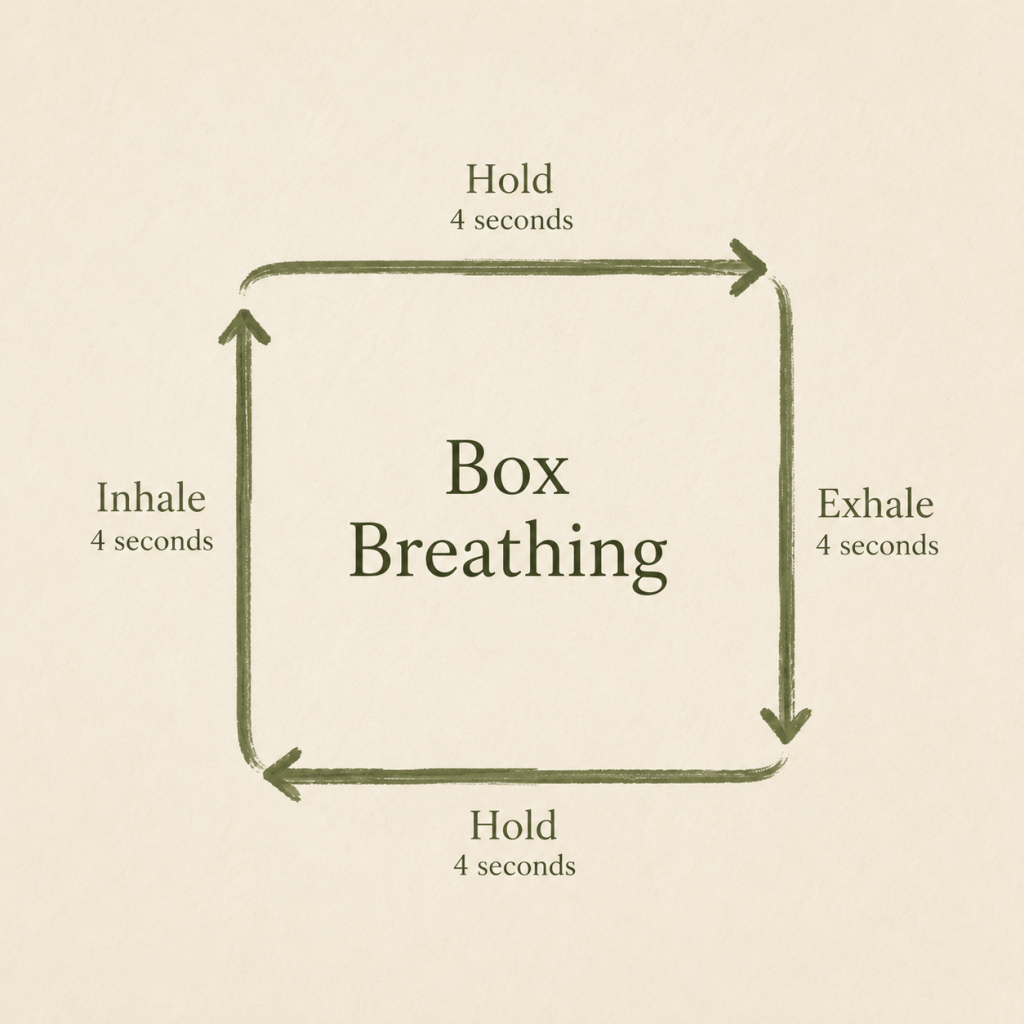
Imagine a perfect square, and let your breath follow its four equal sides:
Inhale for 4: Slowly draw a deep, steady breath in through your nose for a count of four, feeling your belly expand.
Hold for 4: Gently hold that breath at the top for a count of four. Do not clamp your throat shut; simply rest in the stillness of that pause.
Exhale for 4: Release the air through your mouth or nose for a count of four, consciously letting go of the physical tension in your shoulders and jaw.
Hold for 4: Hold the breath out at the bottom for a count of four, resting in the quiet space before the next breath begins.
Repeat this 4×4 cycle four or five times. Try practicing this regularly so it feels more natural during stressful moments.
Intuituve Movement: A Non-Yogi’s Guide to Yoga
Just as the breath can soothe the nervous system, combining that breath with gentle movement can help release tension from our bodies. This brings us naturally to the concept of yoga.
Now, let me be entirely honest with you: I have aspirations, but I am not a traditional “yoga person.” You will not find me twisted into complex, pretzel-like shapes, and I don’t speak the language of a yogi. But I learned that you don’t need to be a yogi to benefit from combining breath with movement.
We can strip away all the intimidation and look at yoga for what it truly is: the simple act of mindfully changing your physical posture to help your body release the stress it’s holding onto. It is mindful movement.
You don’t need a fancy outfit or a studio membership; you just need a few square feet of space on your living room rug.
If your body feels tight and heavy from a long day, you can sink into a gentle child’s pose—kneeling on the floor, sitting back on your heels, and reaching your arms long in front of you as you rest your forehead on the ground. It is a soothing, restorative shape that allows your mind to rest and your back to open up.
Or, if you are feeling closed-in and anxious, you can simply stand tall, reach your arms toward the ceiling, and gently open your chest, creating a little more space for a deep breath.
This isn’t about becoming a yogi, mastering poses, or getting a workout. It is about learning to listen and showing your body that you are paying attention. Instead of pushing through discomfort or overriding what you feel, you are acknowledging it and responding with care.
Mindful movement gives us a way to respond when our bodies ask for something different. A tight neck might ask for gentle stretching. Restlessness might ask for a walk. A stressful day might call for a few quiet minutes on the floor with nothing but your breath.
That simple shift—from ignoring our bodies to listening to them—is one of the greatest gifts we can give ourselves in midlife.
Conclusion: Tuning Into Your Own Rhythm
In midlife, your body is changing its rhythm, and it is asking you to slow down, pay attention, and respond differently in return.
Mindfulness, intentional breathing, and intuitive movement are not about fixing a broken machine. They are about learning to tune into the body that has carried you through decades of life, laughter, tears, and growth.
As you finish reading this, take a moment to practice what we’ve discussed. Feel the weight of your body supported by your chair or the floor. Take one slow, deep breath all the way down into your belly, let it out with a soft sigh, and gently ask your body what it needs from you today.
Then, listen to the answer.

