Perimenopause can feel so confusing.
One minute you feel fine… and the next you’re sweaty, anxious, exhausted, irrationally irritated, and wondering why your body feels so unfamiliar.
And the most frustrating part? You can be doing “everything right” and still feel completely off balance thanks to unpredictable hormone fluctuations.
This is where many women begin looking for support beyond the standard “just deal with it” advice–especially when conventional perimenopause treatments aren’t a viable option for them.
And this is where herbs can shine.
Herbal support works best when it’s part of a bigger picture: nourishing food, consistent movement, nervous system support, and better sleep.
There is simply no magic pill or potion that can override chronic stress, blood sugar crashes, or years of running on empty.
But combined with solid nutrition and intentional lifestyle changes, herbs can make a big difference, especially during perimenopause.
Some herbs specifically support hormonal shifts during perimenopause, while others help ease the secondary symptoms that often arise– things like anxiety, insomnia, brain fog, and nervous system overload.
I want to take a moment to remind you that herbal support looks different than taking a conventional medication for a specific symptom. In most cases, herbs provide gentle, cumulative relief over time. It can take days or even weeks of consistent use to notice their effects, so patience is key.
Your efforts will pay off as you begin to feel steadier, more clear-headed, and more in control of your body again.
In this post, we’re going to cover some of the most accessible and effective herbs for managing the most common (and frustrating) perimenopause symptoms.
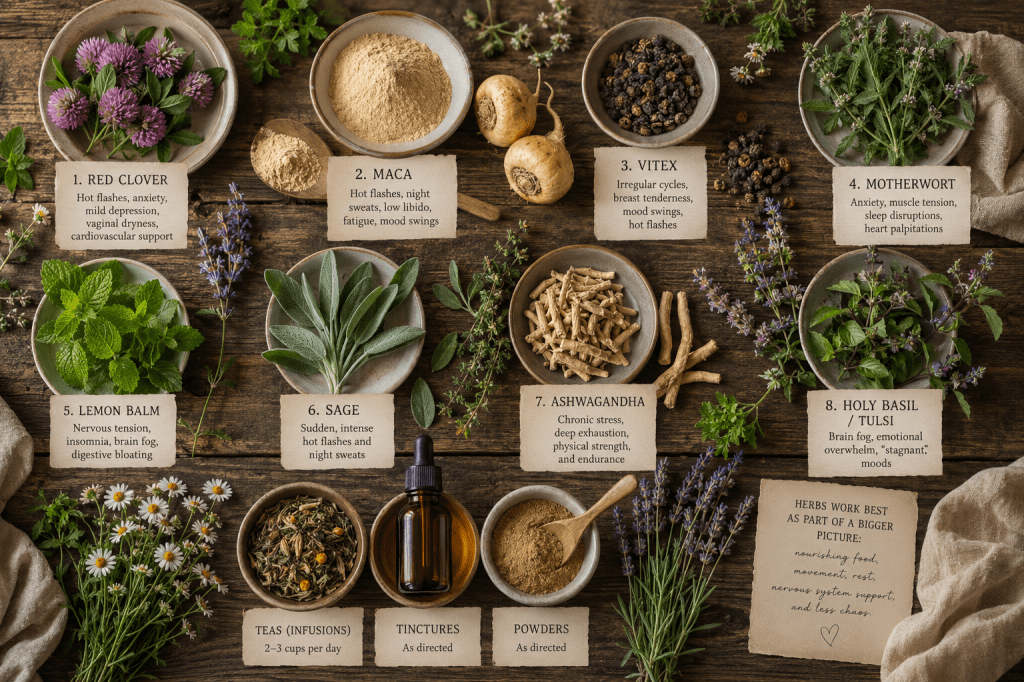
Top Herbs for Perimenopause Support
1. Red Clover (Trifolium pratense)
- Best for – Hot flashes, anxiety, mild depression, vaginal dryness, and cardiovascular support.
- How it works – Red clover contains isoflavones, which are phytoestrogens. This means they can weakly bind to estrogen receptors in the body, helping to smooth out the rocky highs and lows of declining estrogen levels.
2. Maca (Lepidium peruvianum)
- Best for – Hot flashes, night sweats, low libido, fatigue, and mood swings.
- How it works – Also known as Peruvian ginseng, Maca has been used traditionally in Peru as both food and medicine. Maca supports hormone balance without containing plant hormones itself. Instead, it is believed to affect receptors in the brain to support the endocrine system as a whole.
- A Quick Tip – Look for gelatinized maca powder. Because maca is a starch-heavy root, the gelatinization process removes the raw starch, making it much easier to digest. Because it is also a food, you can easily stir a spoonful into morning oatmeal, stews, or daily smoothies.
3. Vitex (Vitex agnus-castus)
- Best for – Irregular cycles, breast tenderness, mood swings, and hot flashes.
- How it works – Also known as chaste tree berry, Vitex is believed to influence the pituitary gland, encouraging the body to optimize its own progesterone production. This can be especially helpful during the early stages of perimenopause when estrogen dominance is common.
- A Note of Caution – Vitex is an example of an herb that is not for everyone. While it works wonders for many, others experience no benefit at all. Furthermore, some women experience an increase in depression or anxiety when taking it. If you have a history of adverse reactions to birth control pills, use extra caution with Vitex.
4. Motherwort (Leonurus cardiaca)
- Best for – Anxiety, muscle tension, sleep disruptions, and heart palpitations.
- How it works – In herbalism, motherwort is known as a gentle nervine and antispasmodic. It calms the nervous system and acts as a cardiac tonic, making it a go-to for that unsettling “racing heart” feeling that can accompany perimenopause anxiety. (Note: Always check with your doctor to rule out underlying issues if you are experiencing new heart palpitations).
- A Quick Tip – Motherwort tea is very bitter! While that bitterness is actually helpful for sluggish digestion and bloating, it is not really pleasant on its own. You may prefer it as a tincture, or blended into a tea with more palatable herbs like chamomile or lemon balm.
5. Lemon Balm (Melissa officinalis)
- Best for – Nervous tension, insomnia, brain fog, and digestive bloating.
- How it works – Lemon balm is a delicious, easy-to-grow herbal powerhouse. It contains compounds that are believed to increase the availability of GABA in the brain, promoting relaxation and mental focus without causing drowsiness. Like many herbs that keep you calm during the day, lemon balm also helps improve sleep quality at night.
- A Note of Caution – While lemon balm is generally very safe, it can suppress thyroid function. If you have an underactive thyroid (hypothyroidism), it’s best to avoid large amounts of lemon balm or consult your healthcare provider first.
6. Sage (Salvia officinalis)
- Best for – Sudden, intense hot flashes and night sweats.
- How it works – You might only think of sage as a culinary herb, but its leaves are highly astringent and have a long traditional history of cooling the body and drying excessive perspiration. A cold infusion of sage can be surprisingly effective for easing the fire of those sudden hot flashes.
The Power of Adaptogens: Your “Resilience Tonics”
Midlife can feel stressful and overwhelming, even before you throw fluctuating perimenopause hormones into the mix. This is where adaptogens come in. These herbs don’t force a specific function in the body; instead, they help your nervous system modulate its response to chronic, everyday stress. They keep you steady, grounded, and functional rather than trapped in that loop of feeling “wired but tired.”
7. Ashwagandha (Withania somnifera)
- Best for – Chronic stress, deep exhaustion, and supporting physical strength and endurance.
- How it works – Ashwagandha works to lower cortisol levels over time, which helps you rebuild your own systemic resistance to the effects of chronic, daily stress.
- Quick Safety Note – Ashwagandha is a member of the nightshade family. If you have a severe nightshade sensitivity or struggle with an overactive thyroid (hyperthyroidism), you may want to skip this one.
8. Holy Basil / Tulsi (Ocimum sanctum)
- Best for – Brain fog, emotional overwhelm, and “stagnant” moods.
- How it works – Often referred to as “liquid yoga” in Ayurveda, Holy Basil is an ancient adaptogen that is said to move stuck emotional and mental energy. It makes a delicious tea that may help improve focus and cognitive function.
What About Black Cohosh?
If you search the internet for menopause and perimenopause herbal support, Black Cohosh (Actaea racemosa) is usually one of the first herbs you’ll see recommended. I personally do not recommend it as a first-line support.
While it can be helpful for some, the commercial market faces major issues with supplement adulteration (where cheap fillers replace the actual herb), ethical concerns with over-harvesting of the wild plant, and rare, but documented concerns regarding liver toxicity.
Because we have so many safer, effective, and sustainable options available to us—like the ones listed above—I prefer to leave Black Cohosh as a last resort when other herbs have already been tried.
How to Take Your Herbs (Forms, Methods & Dosages)
Knowing which herbs can support you is only half the battle, you also need to know the best way to get them into your body. Herbs generally come in three main forms: teas (infusions), tinctures, and powders.
Here is a breakdown of how to prepare each method, along with safe, standard daily dosages to guide your routine.
Herbal Infusions (Teas)
When we use delicate parts of the plant like leaves and flowers, we make an infusion (which is just a fancy herbalist word for tea). To get the medicinal benefits, you need to steep herbs longer than a standard grocery store tea bag. Roots (like Ashwagandha) need to be simmered on the stove, covered, for 30 minutes or longer for the best results.
- Best for – Lemon Balm, Holy Basil, Red Clover, and Sage
- The Standard Recipe – Use 1 to 2 teaspoons of dried herb per 8 ounces (1 cup) of boiling water.
- The Method – Pour boiling water over the herbs, cover the mug or jar with a lid or saucer (this traps the essential oils so they don’t evaporate), and let it steep for 15 to 20 minutes. Strain and enjoy.
- Daily Dosage – 2 to 3 cups per day.
- Note on Sage – For sudden hot flashes or night sweats, make an infusion, let it cool completely in the fridge, and drink it cold before bed or throughout the day.
Tinctures (Liquid Extracts)
Tinctures are concentrated liquid extracts made by soaking herbs in alcohol. They are incredibly convenient, travel well, and absorb quickly. This is the preferred method for Motherwort and Vitex (because their teas are so awful-tasting!)
- Best for – Motherwort and Vitex
- The Method – You can squeeze the drops directly under your tongue, or drop them into an ounce of water or juice to mask the taste.
- Daily Dosage – Motherwort – 1/2 to 1 teaspoon (approx. 2 to 4 droppersful), taken 2 to 3 times a day when anxiety or palpitations flare up. Vitex – 1/2 teaspoon (approx. 2 droppersful) taken once daily.
- Crucial tip – Vitex is most effective when taken first thing in the morning on an empty stomach to properly stimulate the pituitary gland.
Powders
Root herbs are dense and hardy, and using them as a finely ground powder is an easy way to consume them–especially since they also function as nutritive food tonics.
- Best for – Maca and Ashwagandha.
- The Method – Stir them directly into smoothies, morning oatmeal, or yogurt.
- Daily Dosage – Gelatinized Maca – Start with 1 teaspoon daily. You can gradually increase up to 1 tablespoon daily as your body adjusts. Ashwagandha Powder – 1/2 to 1 teaspoon daily. Many women prefer stirring this into warm milk before bed as they find it helpful for sleep. Others, myself included, use it in the daytime as it may interfere with sleep.
Final Thoughts
Perimenopause has a way of forcing us to slow down and pay attention to the things we’ve been pushing through for years.
The lack of sleep. The constant stress. The skipped meals. The habit of pouring from an empty cup while convincing ourselves (and everyone else) that we’re fine.
Herbs can be incredibly supportive during this transition, but they work best alongside the daily habits that truly keep us steady.
Start small, just one steady shift, and build from there.
Slow, steady changes are usually the ones that last.
Disclaimer – Herbs are powerful tools and are not without risk. Everyone is different. If you are pregnant, nursing, taking medications, or managing a medical condition, it’s important to speak with a qualified healthcare professional before starting any new supplements or herbal regimen.These statements have not been evaluated by the Food and Drug Administration. This product is not intended to diagnose, treat, cure, or prevent any disease.

